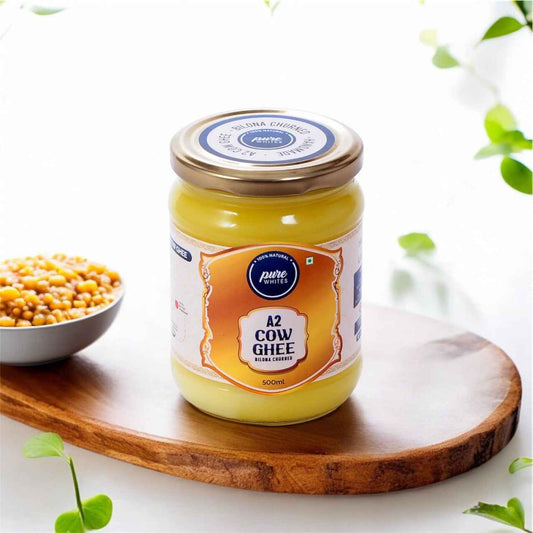
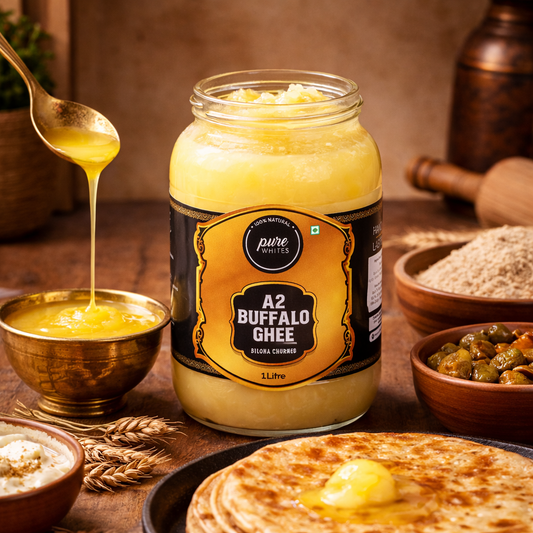
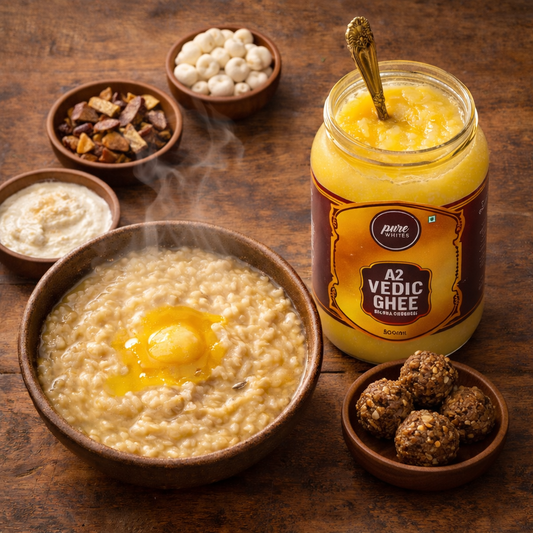
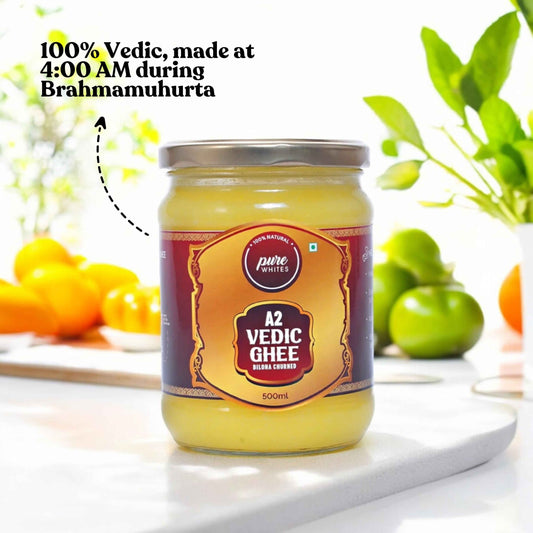
Curd is used instead of cream (malai) to make authentic A2 Ghee because the traditional bilona method requires fermenting milk into curd before churning. This process enhances digestibility, preserves beneficial fatty acids like butyric acid and aligns with Ayurvedic principles making curd-churned ghee nutritionally superior to cream-based factory ghee.
Many ghee brands say “traditional,” but very few actually follow the real bilona method. The biggest difference?
👉 We use curd. Not cream.
This single step changes everything, nutrition, digestion, aroma, texture and even how your body absorbs the ghee.
Let’s understand why.
🥛 Step 1: Milk → Curd (Natural Fermentation)
In the authentic bilona method:
-
Fresh A2 desi cow milk is boiled
-
It is set into curd naturally
-
The curd is churned slowly to extract butter
-
The butter is gently heated to make ghee
This curd fermentation stage is crucial.
Why fermentation matters:
-
Develops beneficial bacteria
-
Improves digestibility
-
Enhances nutrient bioavailability
-
Breaks down milk proteins naturally
💡 Fermentation transforms milk into something lighter and more absorbable.
🧈 Cream (Malai) Skips the Most Important Step
In industrial ghee production:
-
Cream (malai) is separated directly from milk
-
It is heated immediately to produce ghee
-
No fermentation. No curd. No slow churning.
This method is:
-
Faster
-
Cheaper
-
Scalable
But nutritionally, it’s incomplete.
🌿 1. Curd-Churned Ghee Is Easier to Digest
When milk is converted into curd:
-
Proteins are partially broken down
-
Lactose reduces
-
Butyric acid formation improves
This makes curd-churned A2 ghee:
-
Gentler on the stomach
-
Suitable for kids and elders
-
Lighter despite being a fat
💡 This is why many people tolerate bilona ghee better than regular ghee.
🧬 2. Higher Butyric Acid & Gut Support
Butyric acid:
-
Supports gut lining
-
Improves digestion
-
Helps reduce inflammation
The curd-based fermentation process enhances the presence and availability of these beneficial fatty acids.
Cream-based ghee lacks this natural fermentation advantage.
👃 3. Richer Aroma & Authentic Flavor
Curd-churned butter develops:
-
Deeper nutty notes
-
Earthier fragrance
-
A more complex taste profile
Cream-based ghee tends to taste flatter and more uniform.
💡 True bilona ghee smells alive and not standardized.
🧘 4. Ayurveda Recognizes Only Curd-Churned Ghee
In Ayurveda, the term “Ghrita” refers to ghee prepared from:
Milk → Curd → Butter → Ghee
Cream-based direct heating is not described in classical Ayurvedic texts.
Bilona ghee is considered:
-
Satvik
-
Healing
-
Suitable for medicinal use
🌾 5. Texture Tells the Truth
Curd-churned ghee naturally develops:
-
A danedar (grainy) texture
-
Seasonal variations
-
Natural aroma changes
Cream ghee often:
-
Looks overly smooth
-
Remains uniform year-round
-
Lacks authentic grain structure
Texture reflects the process.
💛 Why We Choose Curd Over Cream
At Pure Whites, we choose the longer path because it delivers:
-
Higher nutritional integrity
-
Better digestibility
-
True Ayurvedic authenticity
-
Richer flavor and aroma
-
Naturally grainy texture
Yes, it takes more milk.
Yes, it takes more time.
But it gives you real A2 Ghee & not factory ghee in a premium jar.
✅ Final Thoughts
Using curd instead of cream isn’t just a technical detail, it’s the foundation of authentic bilona ghee.
When you choose curd-churned A2 Ghee, you’re choosing:
-
Fermentation-backed digestion
-
Better nutrient retention
-
True traditional integrity
🥄 Experience real curd-churned A2 Ghee.
👉 Try Pure Whites A2 Ghee